
'Film School Africa' documentary shows filmmaking as art therapy is healing apartheid rifts in South Africa

Community is a powerful thing. It binds people together, gives them a support structure to depend on and gives life meaning. It can also hold a person back, cap their potential and breed structural trauma.
In the documentary 'Film School Africa', Nathan Plaff explores how making films in community schools in South Africa in Kayamandi and Strand helped the black people and people of color from the once segregated "townships" with a chance to build new communities of hope to counter the hopelessness they encountered in their own communities.
The film's synopsis states it is about Katie Taylor, a Los Angeles casting director, who leaves her quickly growing career behind in order to teach filmmaking to youth in an impoverished South African community. While the film does start out like it is going to be a puff piece on Taylor and her non-profit, it quickly becomes involved in the narratives of the young people living in the townships who in Taylor's words were able to "get out" of their poverty-entrenched communities where domestic abuse, street violence, drugs use, and teenage pregnancies are common occurrences.
In South Africa, where apartheid was abolished only in 1991, the wounds are still raw. The systemic segregation and disenfranchisement of black communities created the ghetto "townships", while the white Afrikaans lived in the "suburbs".
The film weaves its way chronologically from when Taylor first came to South Africa and decided to lead a six-month filmmaking program for a few kids who expressed an interest in Kayamandi. When she left, most people thought she would never come back because, in the words of one of the interviewees, "that has happened before".
But Taylor came back, which in itself was a miracle. This first miracle birthed the miracles that followed. Filmmaking became art therapy for the youth who came to the community schools she started, first in Kayamandi and then in Strand.
The topics of the films -- like the effects of alcoholism and domestic violence, of mob justice in these ghetto townships, of abuse -- show that the community schools created a space for the kids to pour out their trauma on paper and then film and make it visible. It is heartbreaking to hear the teenagers say that before film school, no one had asked them what they felt about majorly traumatic events in their life.
From the very beginning, it is made clear that within these impoverished townships, filmmaking is considered as something "white" or "rich" people do. It is a luxury that is so far removed from their reality that the students face opposition from the ones closest to them till they see the film they are making. Some parents even participate in these films as actors, reliving the worst moments of their life, like battling alcoholism. The community schools also became the place to recruit scholarship students for the Film department at Pneumatix College that Taylor collaborated with to create the 'Film School Africa' (FSA) graduate program.
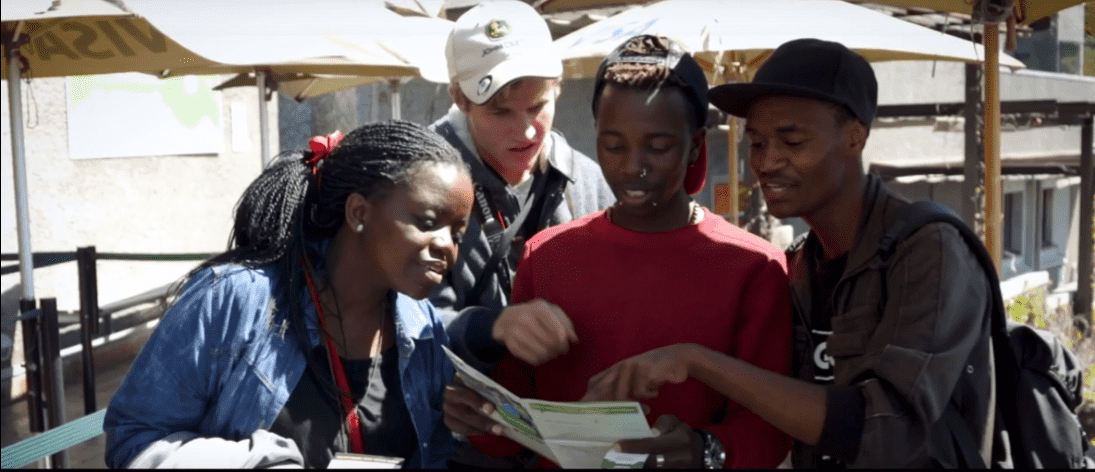
The film shows how the first four full-time students, Tsakane 'TK' Shikwambana, Juan Van Der Walt, Sihle James, and Repholositwe 'Repo' Mpitsa, who came from radically different ethnic and cultural backgrounds became a family unit and a new community of hope as they trained to become professionals who could be employed in the booming South African film industry. It is what makes Juan, a white Afrikaan student who locks his car doors in fear when they go in to film in these areas at the start of the film, to walk alone with his camera, filming footage in those very streets, saying he loves Kayamandi by the time the film ends.
As Sihle James, one of the graduates of FSA, apartheid is too recent a memory, culturally, for communities to mix freely without fear. But with films as the common passion, it is "a way to heal" those rifts and create a brotherhood where none existed before.
'Film School Africa' is available to buy or rent on Amazon and iTunes. Find out more about Film School Africa here.