‘IT: Welcome to Derry’ cheekily reveals whether Pennywise can see the future and why he’s so hard to kill
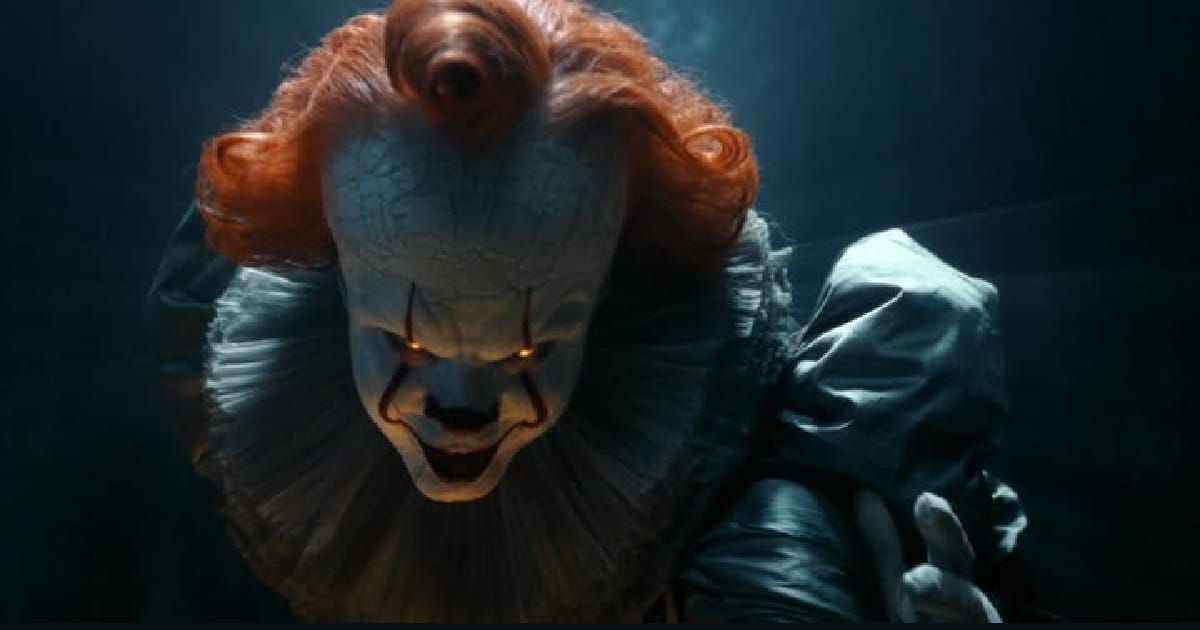
The finale of ‘IT: Welcome to Derry’ delivers one of the most conceptually ambitious moments in the entire ‘IT’ franchise. The prequel reframes Pennywise not just as a monster, but as a being that exists outside humanity’s understanding of time. In the episode’s climax, Pennywise corners Marge in a tense confrontation designed to strip her of any sense of safety. As he feeds on her fear, he reveals a disturbing revelation: a missing-persons poster bearing the name Richie Tozier. Pennywise claims the boy is Marge’s future son, according to DMT. The statement initially feels impossible, given that ‘Welcome to Derry’ is set in 1962 and Richie, as seen in the films, wasn’t born until the 1970s.
Pennywise explains that he does not experience time the way humans do. For him, the past, present, and future coexist simultaneously. Moments are not sequential but layered, allowing him to perceive events across centuries as if they are happening all at once. This perspective turns Pennywise into something closer to a higher-dimensional entity than a traditional horror villain, per ScreenRant. Through this lens, Pennywise already knows that Marge will eventually name her son after her late friend, Rich. Also, Richie is one of the Losers who ultimately helped defeat him in 2016.
That knowledge fuels his twisted logic: if he can kill Marge in 1962, Richie will never be born, and the chain of events leading to Pennywise’s death will be erased. In his mind, this act would secure his survival and grant him a form of immortality beyond 2016, the year of his canonical defeat. However, the show’s bold approach to time immediately opens the door to complex paradoxes. If Pennywise truly exists across all timelines before 2016 at once, then any successful attempt to alter the past should already be reflected in his perception of reality. The fact that he feels the need to change history at all suggests a contradiction in how his powers function.
If Richie was never meant to exist, Pennywise would never have been killed. The dilemma deepens when considering causality. If Pennywise could erase the Losers or their ancestors from existence, the events of ‘IT: Chapter Two’ would never occur. That outcome would invalidate the very motivation driving his actions. Conversely, if the universe operates on a closed, deterministic loop, Pennywise is doomed to fail every time, rendering his threats less meaningful. This philosophical tension arguably weakens Pennywise as an unstoppable force, shrinking the stakes of his cosmic horror.
The only definitive way to destroy him would be to eliminate him at his origin point, when he first arrived on Earth via a fallen star. Yet that solution is impossible, as humanity did not exist at the time. Instead, the burden appears to fall on each generation to confront and defeat him repeatedly. Still, ‘Welcome to Derry’ hints at possible solutions. The finale suggests Pennywise can be psychologically destabilized by individuals with psychic abilities, similar to the “shining.” By forcing him to perceive himself as mortal and time-bound, his godlike awareness collapses. Stripped of his nonlinear existence, Pennywise becomes vulnerable, trapped in the same forward-moving timeline as his victims.