'Skin: A History of Nudity in the Movies': Who was Audrey Munson, first woman to appear nude in the silent era?

If you live in New York City, chances are you have seen her without knowing who she was. She sits atop the Big Apple's municipal building, cast in bronze and at the Frick Mansion, New York Public Library, inside the Metropolitan Museum of Art, by the entrance of the Manhattan Bridge sculpted in stone or chiseled out of copper. Numerous sculptures of her are scattered across the US, yet her name still remains largely unknown. The muse of the Beaux-Arts movement and avant-garde artists of the early 1900s, she was America's first supermodel, and also the first Hollywood flameout story. Audrey Munson was her name and she was the first woman to bare it all out in the films of the silent era.
Danny Wolf's 'Skin: A History of Nudity in the Movies' is a 130-minute documentary that examines the legacy of nudity in Hollywood and how it has always pretty much been a selling point for films. Nudity has been part of film since the dawn of the industry and the invention of the cinematograph by the Lumiere brothers in the late 19th century. The unscripted film features interviews with well-known actors and actresses who have appeared naked in films at some point in their lives, along with directors, art historians, and casting directors. The film makes notable mention of Munson, the woman that defined mainstream nudity in the 1910s.
Born in 1891, Munson grew up a beautiful woman, with a classically beautiful body and the courage to "brazen it out" in all her glory, in the name of art. In the early 20th century, Munson and her figure of Grecian proportions inspired a generation of neoclassical American artists, who basically deemed her the modern-day Venus de Milo. She was also nicknamed 'American Venus', 'Miss Manhattan', and the 'Queen of the Artist's Studio'. But just as quickly as she achieved widespread fame after entering the nascent movie industry, her downfall had become inevitable, and by the roaring twenties, the young beauty had retracted into obscurity (though not by choice) where she far outlived her short glamorous career.
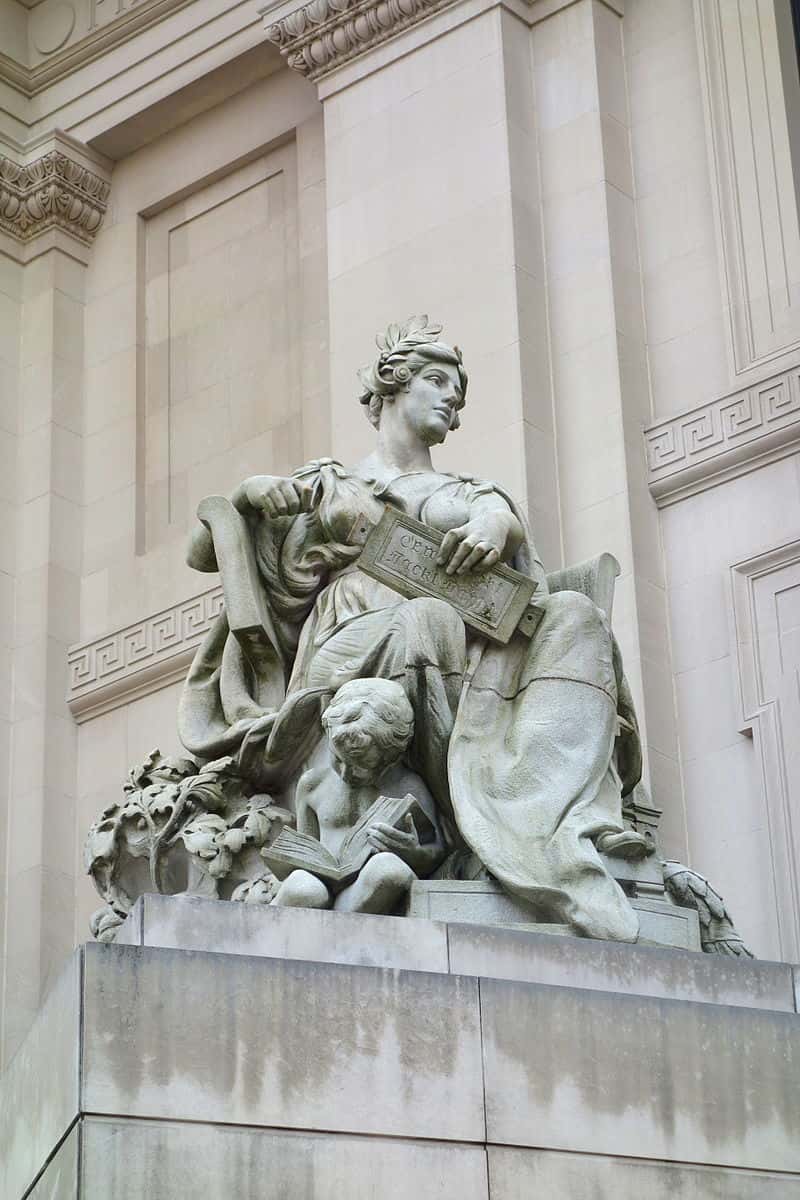
Munson, who began her New York career working as a Broadway chorus girl, was discovered by a polymath photographer, Felix Benedict Herzog, when she was window-shopping along Fifth Avenue. She was 15 at the time, and Herzog introduced her to a circle of artists, one among them managing to persuade her to pose for him nude. Between 1910 and 1915, Munson modeled as a goddess or an allegorical image thereof, becoming the inspiration for over two dozen sculptures in New York City alone. Her work had garnered her both fortune and fame, and in 1916, she moved to California to work in the motion picture industry which was still very much in its infancy.
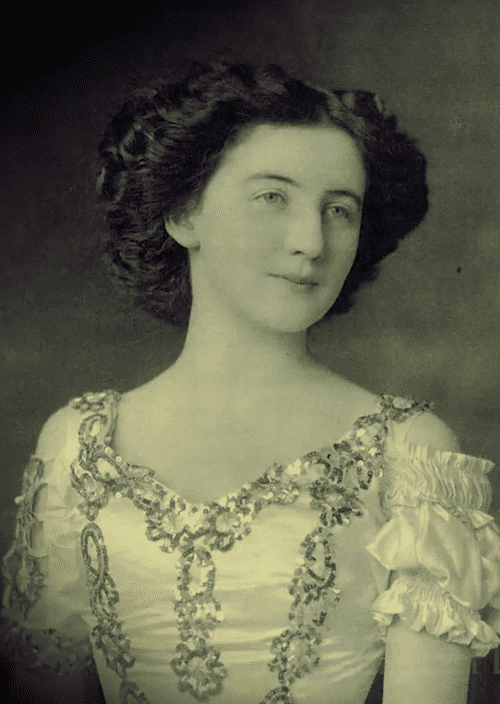
In her debut film, 'Inspiration', Munson disrobed on camera for the first time, playing a sculptor's model onscreen. It became the first non-pornographic film to feature a nude woman. At the height of her career, Munson was a force to reckon with and completely squashed society's prudish ideas on how a woman should appear in public. She refused to wear a corset and high-heels and believed that a woman's dress should be natural and practical. She acted in three more films before she returned to the East Coast and dated slew of rich men in New York and New Port including Hermann Oelrichs Jr, who was the richest bachelor in America at the time.
By 1922, at 39 years old, Munson, the 'once-famous artists model' was forced to kiss her golden career goodbye after she began to show signs of trouble. Her mental state had started to deteriorate and she began claiming spurious connections to European aristocracy, going as far as to call herself 'Baroness Audrey Meri Munson-Munson'. In 1919, she wrote a rambling letter to the US State Department where she alleged that Oelrichs Jr belonged to a pro-German cabal that drove her out of Hollywood. She also blamed many of her troubles on Jews and even filed a petition with the US House of Representatives to pass a bill that would protect her from being "persecuted by Hebrews".
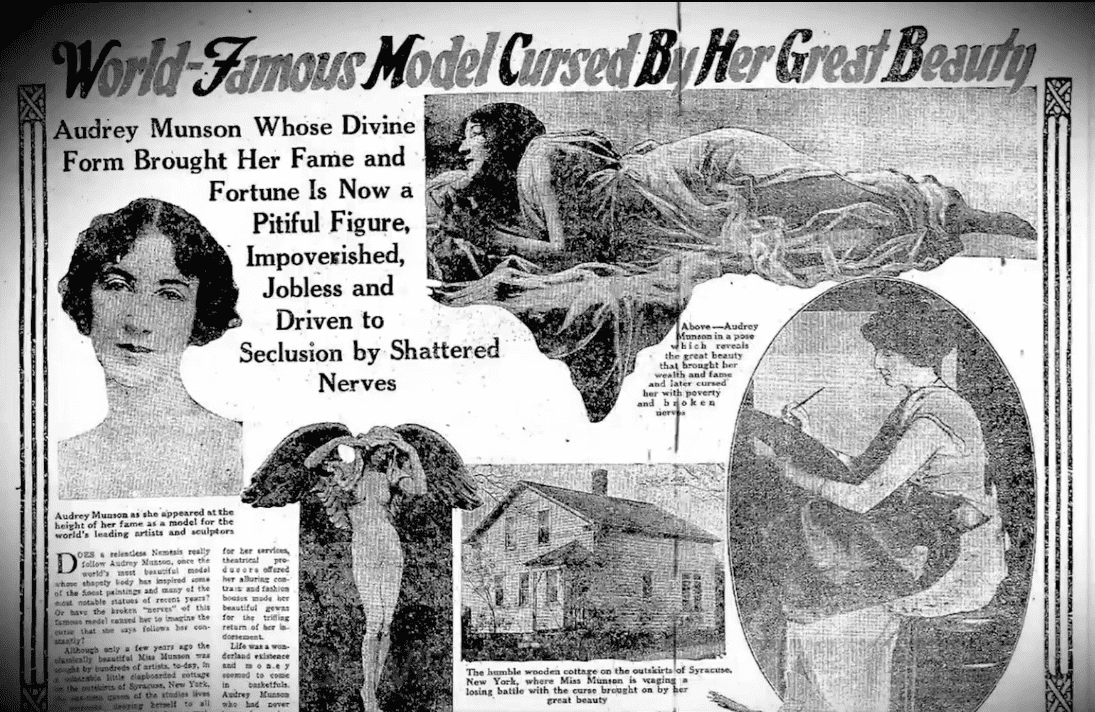
She and her mother had been living in a boarding house in New York, at the time, which was owned by an elderly doctor named Walter Wilkins. In February 1919, Wilkins bludgeoned his wife Julia to death outside their Long Island home. During the course of investigating the murder, the police realized that Wilkins' obsession with Munson had possibly resulted in him killing his wife, so he could be with her. Though Munson and her mother had left New York before the murder, the police tracked them down in Canada and the former actress denied any involvement with Wilkins, who was later found guilty and sentenced to death. Before he was to be electrocuted however, Wilkins hung himself in his cell. The publicity from this scandalous case ruined her career.
Munson tried to commit suicide in 1922 by ingesting bichloride of mercury, and on her 40th birthday and her mother petitioned for her to be committed to an insane asylum in Ogdensburg, New York. She remained there for 65 years, and died at the age of 104, in 1996. She was buried in an unmarked grave in New Haven Cemetery until her family installed a simple gravestone on her 125th birthday. Munson always believed that her demise would result from gypsy's curse that she had encountered at 5 years old.
'Skin: A History of Nudity in the Movies' will be available on-demand on August 18.