
Families of tragic Titan crew could get no payout from OceanGate due to quirk in maritime law
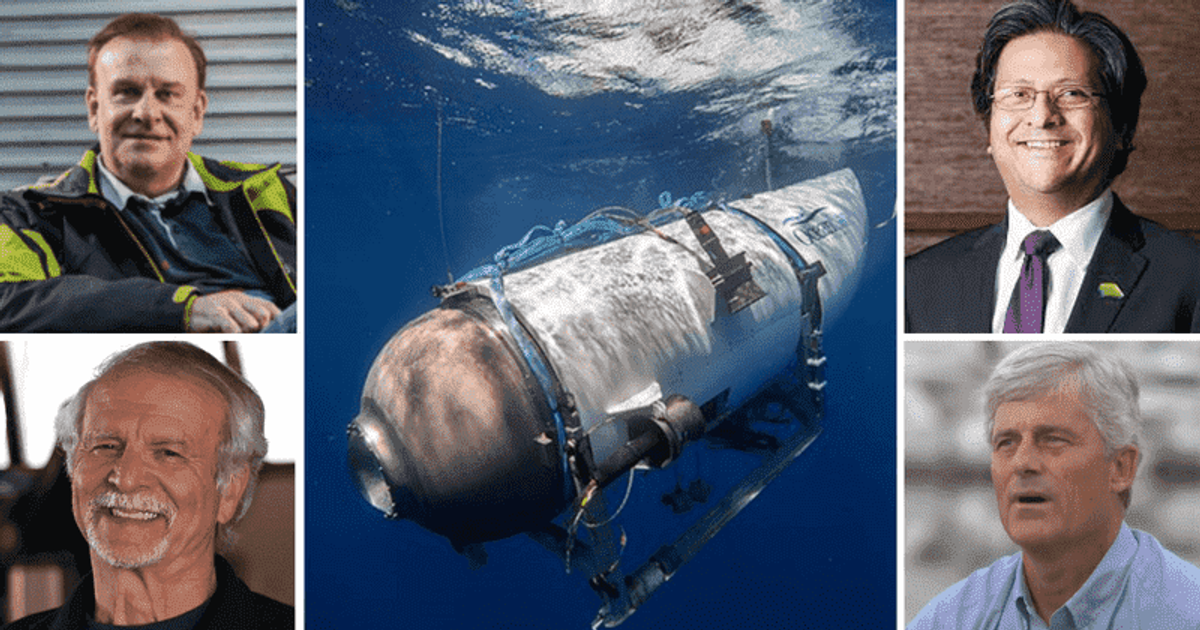
NEWFOUNDLAND, CANADA: The devastated families of five crewmen, who died on the missing Titan submersible might not receive any compensation from Oceangate due to a discrepancy in maritime law. The crew members, dubbed as Titanic Five, were killed instantly after the submersible suffered a "catastrophic implosion" just 1,600ft from the bow of the wrecked ocean liner, the US Coast Guard announced.
The victims on board the Titan sub included British billionaire Hamish Harding, French explorer Paul-Henri Nargeolet, OceanGate CEO Stockton Rush, Pakistani millionaire Shahzada Dawood, and his son Suleman. The vessel lost communication with its mothership MV Polar Prince after 4 am on Sunday, June 18, when it was taking a team of five people to view the Titanic shipwreck off the coast of Canada. Titan’s disappearance prompted an extensive search which drew to a devastating close when a remote-operated submarine from a Canadian ship found debris on the ocean floor.
Can Oceangate shield itself from damage?
Although it appears that OceanGate would be held accountable for whatever happened to Titanic Five, the legal complexities surrounding Titan make things more difficult for victims’ families. A Reuters report on the probable legal issues OceanGate would face in the future mentioned several intriguing peculiarities regarding how maritime law functions in these circumstances. As per the report, the OceanGate, a Washington-based company can make an attempt to safeguard itself from liability by bringing a limitation of liability action under maritime law, which entitles owners of vessels involved in accidents to urge a federal court to restrict any damages to the present worth of the vessel.
Since the Titan was destroyed, Reuters notes, “the damages would be zero." But to do this, OceanGate would need to prove it had no knowledge of potential defects with the submersible and would carry the burden of proof, which is a hard standard to meet. Another maritime law, the Death on the High Seas Act, limits the amount people who were financially dependent on another who died in a naval accident to only a portion of their future earnings. Plaintiffs also cannot recover losses for pain and suffering.
Can victims’ families sue Oceangate?
The victims' families will likely struggle to sue the company due to a waiver that all the passengers signed before traveling on the vessel. The waivers apparently went into great detail on the risks involved with exploring the ocean's deepest regions in a submersible the size of a minivan. "Federal maritime law would govern whether the waivers are valid," Kenneth Abraham, a distinguished professor of law at the University of Virginia, told Newsweek. He further added that "But by analogy, in most states, the waivers would be valid in this situation, and depending on their wording the waivers would bind the families too."
However, Los Angeles personal injury attorney Miguel Custodio claimed that the families could only bring a lawsuit against OceanGate if it could be proved that a crew member's carelessness was to blame for the disaster. "I don't see much recourse for these families in court, or how this waiver could be challenged unless it's discovered that someone on the ship's crew controlling it was negligent in the way it was being operated and that caused the submersible to be lost," he told DailyMail, adding "If this turns out to be a tragedy, the families might consider pursuing legal remedies under an "ultrahazardous activity" tort, which would require the activity they were engaged in to be uniquely dangerous and that the defendant's actions were the cause of injury."


